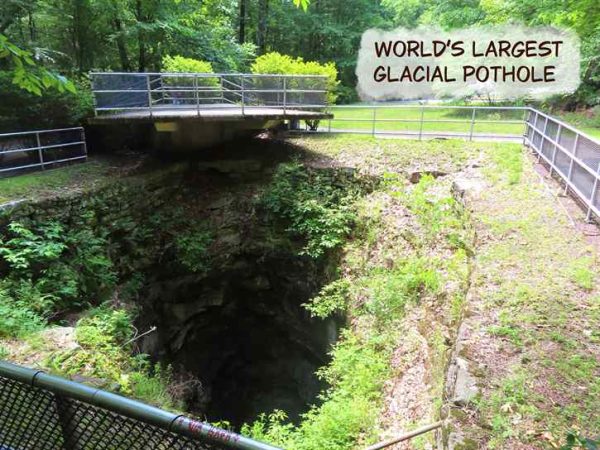
Bet you didn’t know Pennsylvania is home to the World’s Largest Glacial Pothole!
And it’s not too far from any of the major cities! Only a quick 2.5 hour drive from both Philly and New York City! A bucket list stop that should be added right next to Time Square if you ask me. And as a special bonus, you get to see a ton of road potholes on your way as you venture from either city! Yay.
For me, I had pleasure of viewing upon this beauty as one of my first stops on a summer road trip across the United States.
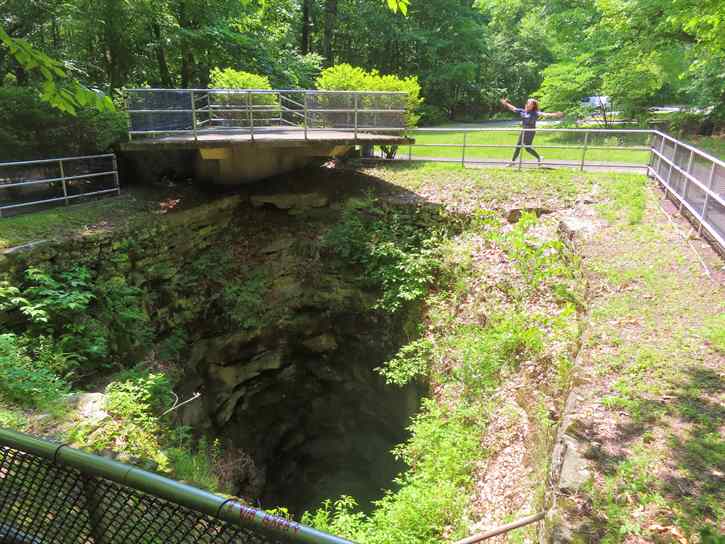
The World’s Largest Glacial Pothole is located in Archibald Pothole State Park. The pothole enterance is right off the highway. This small section of the park consists of a large parking lot with a picnic area surrounding the fenced off pothole.
When I rolled up, there were 5 other cars in the parking lot. Everyone was hanging out in their car so the vibes were a bit sketchy. But I just told myself that they are all here because they are super passionate about glacial potholes. No other reason.
I gathered my equipment, which consisted of my camera and tripod and head walked towards the pothole. My first impression was wow, that’s a huge hole in the ground, so I was clearly not disappointed. I made my way onto the concrete viewing platform and gazed down into the depths. I’m a terrible estimator so at this point I could not tell you how deep she really went. Could be feet, could be miles. Most likely somewhere in between.
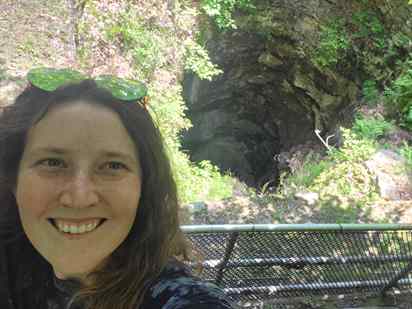
After gazing into the depths for a decent amount of time, I began to scope out the best place to position my tripod. Capturing this photo, turned out to be more challenging then some of the other world’s largest. I was faced with the dilemma of having to fully run around the perimeter of the pothole, in 10 seconds, to get into frame. Normally, I can run straight to the world’s largest object and have time to pose. But in this case, it is a a very large hole in the ground and gravity would work against me if I tried.
So naturally this process took some trial and error to figure out. From an outside perspective, I probably looked a bit crazy. I would hit the timer, jump off the rock pile that my tripod was placed on and sprint towards the concrete platform. After many failed attempts, since I am not the Flash and cannot run at the speed of lightning (sadly). I found a spot where I could realistically end up before the timer went off. So posing at the side of the pothole would be as good as it gets.
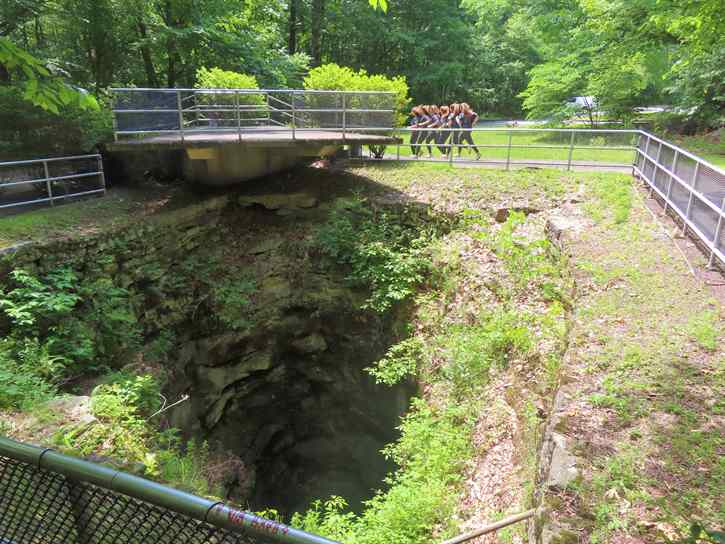
Some of my many attempts to get to that platform
I then packed up my equipment and walked over to read the information sign to learn more about this glorious hole. Sadly, the sign left much to the imagination so I had to do some further research to be satisfied.
And this is the story of the World’s Largest Glacial Pothole:
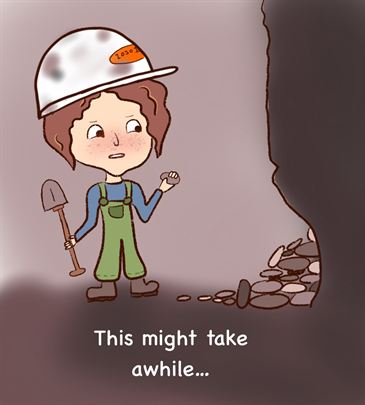
Originally, the grounds around the site were used as a mine. In 1884, the mining company was looking to expand their existing mine so they set up routine explosives. Immediately after the blast, water and stones came pouring into the active mine. After the initial scare, the boss ordered that the area be cleared of the fallen debris. At that time, I doubt that he anticipated that they would be clearing 800-1000 tons of smooth and oval stones from the area. And only after this was done, they discovered the large and I mean LARGE vertical tunnel.
The pothole measures to be 38-42 feet deep and 24 feet in diameter. This pothole is so large that is could hold 140,000 gallons of melt water and to put that in perspective, it could hold about 3-5 fire trucks.
After it’s discovery, the pothole served as a ventilation shaft for the mine. When the mine closed down the owner opened the land to scientists and tourists. And apparently it became quite the attraction. There was a dedication ceremony in 1887, giving it the title of World’s Largest Glacial Pothole. For safety, they then spent $500 (which is approximately $17,000 in today’s dollar) to build a wall and fence around the pothole. The landowner would give tours to the general public and to scientists wishing to study the pothole.
I do however, think it was a missed opportunity since they didn’t include a gift shop to go along with the tour. Just imagine the all the cheesy merch that you could make for this attraction!
In 1914, the pothole was turned over to public ownership. In 1961, the commonwealth of Pennsylvania began the preservation of the pothole, but in the 90s, attendance had fallen and facilities were in need of repair. So the park closed for a $170,000 renovation and reopened in 1997. And it has been thriving as a park ever since.
Now, you must be wondering how in the heck did a giant pothole come to be?
The pothole was formed during the Wisconsin Glacial Period, 20,000 years ago. And if you’re like me who had no idea what that really means, well the Wisconsin Glacial period was the most recent glacial period. During this time, ice sheets covered most of Canada, the areas between the Upper Midwest and New England and even parts of the west. Hard to believe that all these areas, now full with life, were once under huge ice sheets!
Well during a span of 20,000-30,000 years, these ice sheets, otherwise known as glaciers, went through various melting and freezing periods. Glaciers in general have the power to radically alter the geography of the surrounding areas. And boy did they! A glacier can grind away solid rock, deepen existing valleys, carry huge amounts of sediment, and reshape mountain slopes.
Glaciers are truly powerful beasts. Which is why they have a whole field dedicated to studying them. If you want to see exactly how the Wisconsin Glacial Ice Sheets moved in this region check out this youtube video to get a better idea.
So back to our pothole!
There are many theories on how this pothole has come into existence. One that is still commonly believed today is that the pothole was carved into the ground by a waterfall falling through a crevasse in the glacier. A recent addition to this hypothesis places a lake on top of the glacier as a long term water supply for the waterfall.
On the other hand, the opposing belief is that there was no waterfall and instead argue that there was a large, fast moving stream of water under the glacier supplied the swirling water that created the pothole. And after years and years of constant spinning the stones and sand carved out an elliptical hole.
Which theory you choose to believe? I personally like the waterfall theory, but that’s just because I am a sucker for waterfalls. Either way, the pothole was then hidden to our eyes and preserved underground for nearly 15,000 years. A truly remarkable stop if you ever find yourself in Archbald, PA.